
World Cities Day 2026 to explore how urban regeneration can advance adequate housing for all
When insecurity forced Salamata Bagagnan to flee Arbinda, in northern Burkina Faso, amid attacks by armed groups and growing insecurity in the region, she left her home and belongings behind. She and her family headed to Nagréongo, near the capital Ouagadougou, in search of safety.
“Following multiple attacks on our village, we were forced to flee. We left our husbands, our belongings, our entire lives behind, and came to seek refuge in Nagréongo,” Salamata recalls.
The traditional chief of Nagréongo offered the family temporary accommodation, but space was limited and living conditions were difficult. They struggled to access drinking water and sanitation, while the cost of renting a house each month left less money for other household needs.
“When we arrived, we had no roof over our heads. It was very difficult,” she says.
Salamata’s experience reflects the difficulties facing families displaced by Burkina Faso’s security crisis. By March 2023, more than 2 million people had been reported internally displaced across the country, according to figures cited by the Office of the United Nations High Commissioner for Refugees (UNHCR). For those forced to leave their homes, finding somewhere to live is an immediate concern. Securing an income and accessing basic services can be just as difficult in the communities where they seek refuge.
A home of their own
Salamata’s family now lives in a newly built house in Nagréongo, provided through a UN-Habitat project funded by the Government of Japan. They no longer have to pay rent each month, easing the pressure on their household budget.
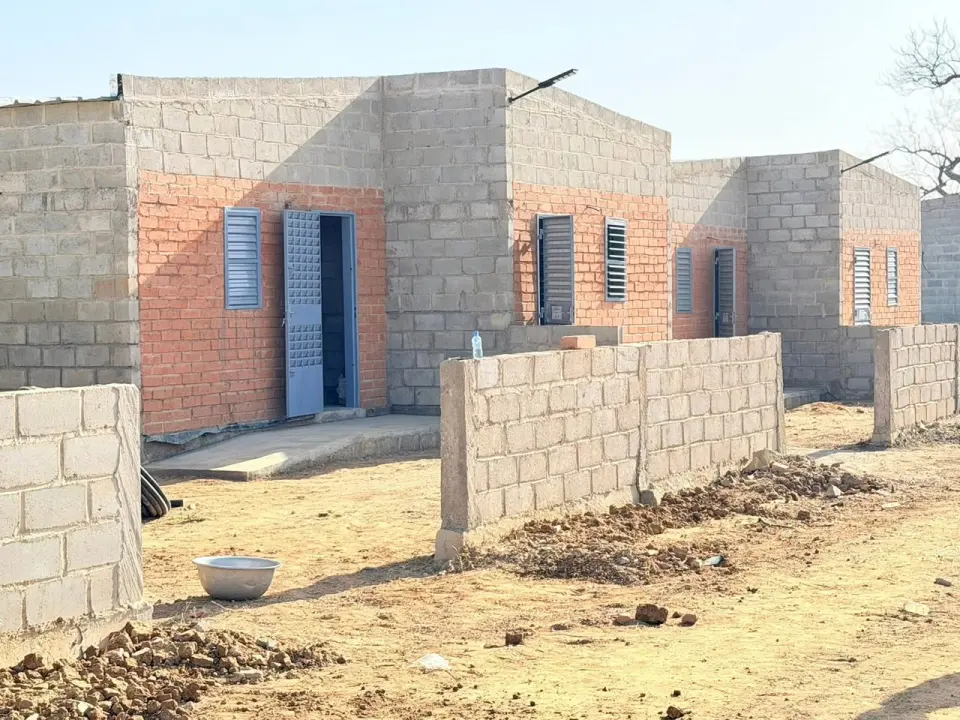
Houses built for displaced families and vulnerable host households in Nagréongo, Burkina Faso, under the IPDCA-BF project implemented by UN-Habitat and funded by the Government of Japan. The project has supported the construction of 300 housing units in Nagréongo and Boussouma. © UN-Habitat/Yasmina Sienou
Implemented by UN-Habitat in partnership with authorities in Burkina Faso, the Project for the Social and Economic Inclusion of Internally Displaced Persons and Host Communities in Urban Areas (IPDCA-BF) has supported the construction of 300 housing units: 150 in Nagréongo and 150 in Boussouma.
Built using locally sourced materials and taking account of local building practices, the houses provide displaced families and vulnerable host households with a more stable place to live.
“Japan’s goal is not just to build houses, but also to restore confidence, dignity and hope to the most vulnerable households,” said Jun Nagashima, Ambassador of Japan to Burkina Faso.
For Salamata’s family, having a home of their own has eased the immediate pressure of finding accommodation. But settling into a new community also means being able to meet everyday needs and find ways to earn a living.
Water and a way to earn a living
When Salamata arrived in Nagréongo, access to drinking water was among the difficulties her family faced. Through IPDCA-BF, UN-Habitat supported boreholes and a simplified drinking water supply system to improve access to water for displaced households and host communities.
The project also installed water storage infrastructure near Salamata’s home to support farming. Alongside the water infrastructure, families received household installation materials, hydroponic farming equipment, and technical and entrepreneurial training.
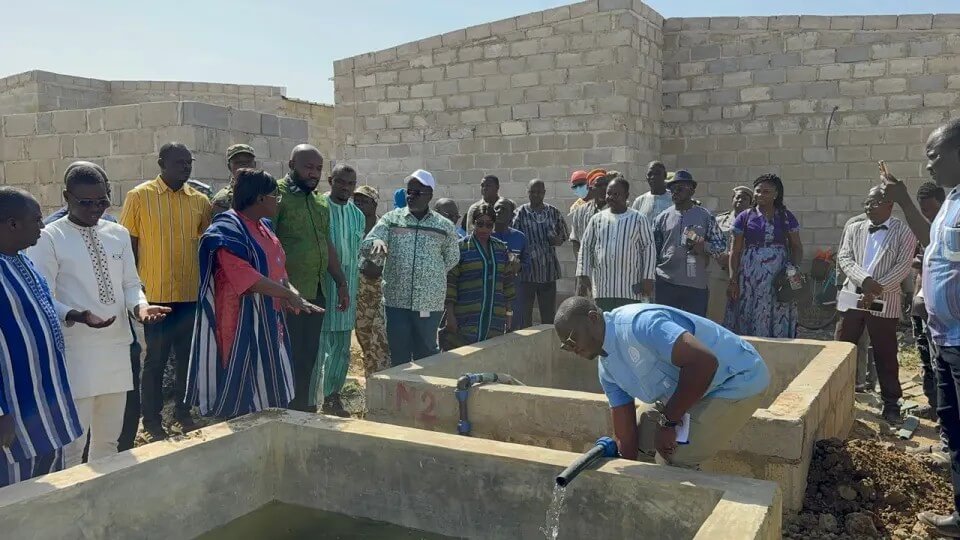
A delegation looks on as water flows into storage tanks built under the project. The facility is intended to support hydroponic farming. © UN-Habitat/Yasmina Sienou
Hydroponic farming allows plants to grow without soil. It can offer an alternative for households with limited access to agricultural land, provided they have the necessary water, equipment and skills.
“This will allow us to engage in income-generating activities,” Salamata says.
The support is intended to help families produce food and develop activities that can bring in income. For households rebuilding their lives after displacement, opportunities to earn a living can help reduce dependence on outside assistance and make it easier to meet everyday expenses.
A new start for displaced families and their hosts
Nagréongo has welcomed families who, like Salamata’s, have fled insecurity elsewhere in Burkina Faso. Their arrival brings additional demand for housing, water and other basic services in a community whose own residents also need access to these resources.
The traditional chief’s decision to offer Salamata’s family temporary accommodation helped them when they first arrived. The project builds on this local support by investing in housing, water infrastructure and livelihood opportunities for displaced people and vulnerable host households in both Nagréongo and Boussouma.
By addressing these needs together, IPDCA-BF aims to improve living conditions and support social inclusion and peaceful coexistence between displaced families and the communities receiving them.
For Salamata, the change is already tangible. Her family has a home of its own, and the support provided through the project offers opportunities to build a more secure future.
“Today, we give thanks, because these homes have saved us,” she says. “These homes have changed our lives.”
Cover photo: Women participate in technical and entrepreneurial training supported under a UN-Habitat project in Burkina Faso. © UN-Habitat/Yasmina Sienou
Legal Disclaimer:
EIN Presswire provides this news content "as is" without warranty of any kind. We do not accept any responsibility or liability for the accuracy, content, images, videos, licenses, completeness, legality, or reliability of the information contained in this article. If you have any complaints or copyright issues related to this article, kindly contact the author above.
